In 2004, Elissa Epel and her colleagues at the University of California, San Francisco measured something in a group of mothers that changed the direction of aging research. The mothers were caring for chronically ill children — the kind of care that never lets up, that wakes you at 3 a.m. listening for a change in breathing, that compresses years into months of vigilance and exhaustion. Everyone who knew these women could see what the stress was doing to them.
Epel’s team proved it was worse than anyone realized.
When they measured the telomeres of these mothers — the protective DNA caps at the ends of chromosomes that shorten as cells age — the numbers showed roughly a decade of additional biological aging compared to mothers of healthy children. The stress had not just worn these women down. It had aged their cells, measurably, at the level of their DNA. They published the findings in the Proceedings of the National Academy of Sciences, and the study opened a field.
The implication was difficult to sit with. Stress doesn’t just feel like it ages you. It does age you — written into the architecture of your chromosomes. And for the researchers who understood what telomeres mean for long-term health, a question became unavoidable: if stress can do this, can anything protect against it?
The Protective Caps — and the Enzyme That Rebuilds Them
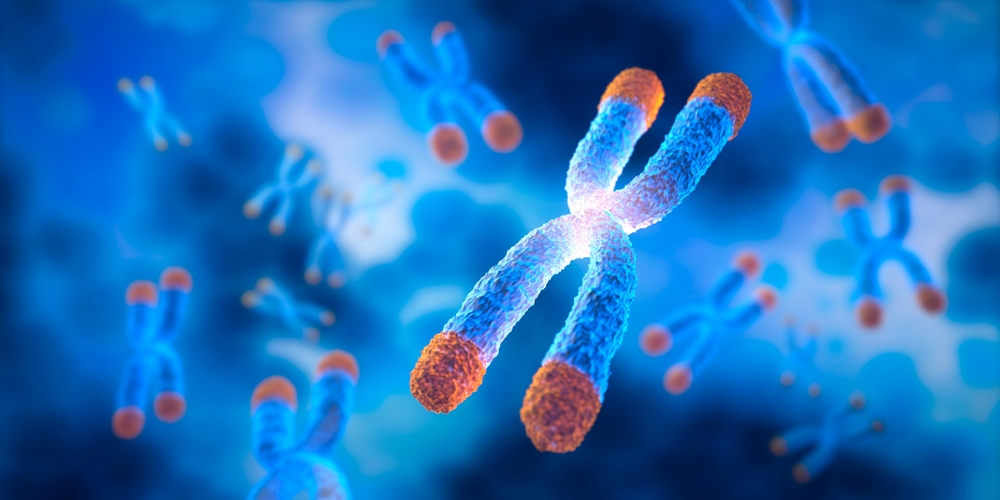
Your chromosomes are long threads of DNA. At their tips sit telomeres — repeated stretches of a six-letter sequence (TTAGGG) that serve as protective caps. The analogy researchers use is the plastic tip on a shoelace. Without it, the lace frays. Without telomeres, chromosomes fuse, degrade, and malfunction.
Every time a cell divides, it loses a small piece of telomere. Alexei Olovnikov described this limitation in 1971. Over a lifetime, the caps erode. When they get critically short, cells stop dividing or die. Shorter telomeres have been associated with markers of accelerated aging and reduced healthspan. Two people born the same year can have very different telomere lengths depending on genetics, lifestyle, and accumulated stress. Researchers now treat telomere length as a biomarker of biological aging — one that can diverge sharply from the number on your driver’s license.
Then there is telomerase. Elizabeth Blackburn and Carol Greider discovered this enzyme in 1984. It is the only enzyme in the body that can lengthen telomeres, adding TTAGGG repeats back onto chromosome ends. In 2009, for their research that led to the discovery of telomerase, Elizabeth Blackburn, Carol Greider, and Jack Szostak were awarded the Nobel Prize in Physiology or Medicine.
The biology sets up a tug-of-war. Telomeres shorten with each cell division and under stress. Telomerase rebuilds them. Anything that accelerates the shortening or suppresses the repair tips the balance toward faster aging. And that is exactly what chronic stress does — it floods the body with cortisol, spikes pro-inflammatory cytokines like IL-6, and generates reactive oxygen species that directly damage telomeric DNA. The TTAGGG sequence is especially vulnerable because it is rich in guanine, the nucleotide most susceptible to oxidative attack.
Epel’s caregiving study had shown the damage. Two trials at Ohio State would test whether it could be prevented.
The 2013 Trial: Omega-3 and Telomere Length
The researchers who designed this trial, published in Brain, Behavior, and Immunity in 2013, brought together decades of converging evidence. Janice Kiecolt-Glaser, a Distinguished University Professor at Ohio State who directs the Institute for Behavioral Medicine Research, had spent her career demonstrating that psychological stress alters immune function, impairs wound healing, and raises inflammatory markers. Her work helped establish psychoneuroimmunology as a discipline. Elizabeth Blackburn had co-discovered telomerase. Elissa Epel’s caregiving study had shown that stress shortens telomeres. Jue Lin at UCSF had developed the assays that measure telomere length and telomerase activity in blood.
What no one had tested in a controlled human trial was whether an anti-inflammatory intervention could protect telomere length from the damage these researchers had spent their careers documenting.
They needed a formulation built around EPA. At the time, most omega-3 research focused on DHA for brain membrane fluidity. But Kiecolt-Glaser’s team was interested in inflammation, and the scientific literature pointed to EPA as the omega-3 with the stronger anti-inflammatory effects. They selected a high-EPA concentrate with a 7:1 EPA-to-DHA ratio, delivering 347.5 mg EPA and 58 mg DHA per 500 mg gel capsule — the concentration their hypothesis required. The supplement manufacturer supplied capsules and placebo controls without charge and without restrictions on study design, data collection, analysis, or publication. The NIH funded the research independently.
They enrolled 106 sedentary, overweight, middle-aged and older adults in a double-blind, placebo-controlled trial lasting four months. The population was deliberate. People living in a chronic low-grade inflammatory state — elevated IL-6, higher oxidative stress — the kind of biological environment that grinds telomeres down. If a supplement could shift the needle here, it would mean something. The high-dose group took six capsules a day, delivering 2,085 mg EPA and 348 mg DHA. The low-dose group took three. Placebo capsules mirrored the fatty acid profile of the typical American diet. All were coated with fuchsia dye so no one could tell which group they were in.
What the data showed
Omega-3 supplementation lowered F2-isoprostanes — the gold-standard marker of oxidative stress — by about 15 percent compared to placebo (p = 0.02). Less oxidative stress means less damage to telomeric DNA.
The telomere finding was more nuanced and, arguably, more revealing. The group-level comparison between supplement and placebo did not reach statistical significance on its own. But when the researchers looked at what actually changed in each participant’s blood — the ratio of omega-6 to omega-3 fatty acids — a clear dose-response emerged. Each one-unit decrease in the n-6:n-3 ratio predicted roughly 20 additional base pairs of telomere length (p = 0.02). In the placebo group, telomeres shortened over four months, consistent with normal aging. In participants whose ratio improved, telomeres were maintained or lengthened.
Not every participant responded the same way. Some already had a lower ratio going in, perhaps because they ate more fish or less processed food. The supplement had less room to move their ratio. Others started with the high omega-6 load typical of the Western diet — ratios of 15:1 or even 20:1, compared to ancestral estimates of 2:1 to 4:1 — and in those participants, the supplement produced a large shift. The degree of that shift was what predicted telomere length. Not the pill count. Not the dose alone. What mattered was whether the omega-3 actually changed the inflammatory balance in each person’s blood. And in those where it did, the impact went all the way to protecting their DNA.
The 2021 Trial: Telomerase Under Stress
The 2013 trial showed that omega-3 can reduce oxidative stress and support telomere maintenance. But it left something unanswered. What happens to telomerase — the repair enzyme itself — when the body is hit with acute stress? If stress shortens telomeres and also suppresses telomerase, the body loses its only repair mechanism at exactly the moment it needs it most. The damage compounds.
Annelise Madison led this ancillary substudy, published in Molecular Psychiatry in 2021, from Kiecolt-Glaser’s lab, with Epel and Lin contributing from UCSF. Rather than simply supplementing and measuring at two time points, they subjected participants to a validated stress protocol and tracked the biological response in real time.
Participants from the same parent trial — 138 in this analysis — underwent the Trier Social Stress Test after four months of supplementation. They had to deliver an impromptu speech before stone-faced evaluators and perform difficult mental arithmetic out loud while being corrected on every mistake. It is the gold standard for inducing acute psychological stress in a laboratory. Blood was drawn at multiple time points before, during, and after the stressor. The team measured telomerase activity, IL-6, IL-10, and cortisol.
What happened
In the placebo group, telomerase activity dropped about 24 percent between 45 and 120 minutes after the stress test (p = 0.001). The body’s only telomere-repair enzyme was shutting down under stress.
In both omega-3 groups — three capsules or six — telomerase held steady. It was not suppressed.
The anti-inflammatory cytokine IL-10 followed the same pattern. In the placebo group, IL-10 declined significantly by two hours post-stress (p = 0.004), leaving placebo participants with IL-10 levels 26 percent lower than the high-dose omega-3 group at that time point. At the higher dose, the benefits extended further: IL-6 levels were 33 percent lower than placebo (p = 0.007) and cortisol was significantly reduced. The three-capsule dose preserved telomerase and IL-10 but did not move cortisol or IL-6, suggesting a dose-response relationship for the broader stress-buffering effects.
Think about what this means in practical terms. Under stress, the body suppresses the one enzyme that can repair telomeres — at exactly the moment stress is doing the most damage. This trial showed that in the group receiving high-EPA omega-3 supplementation for four months, telomerase activity was maintained. At the higher dose, it also reduced the stress hormones and inflammatory signals causing the damage in the first place. This was not observational. It was a blinded, controlled trial with an objective laboratory stressor and blood-based biomarkers measured in real time.
Why EPA — Three Molecular Pathways
The results from these trials trace back to well-characterized molecular biology, and they explain why the formulation’s EPA-to-DHA ratio mattered.
At the most basic level, EPA competes with arachidonic acid — an omega-6 fatty acid — for the same enzymatic machinery. In 1982, Bergström, Samuelsson, and Vane received the Nobel Prize in Physiology or Medicine for working out how arachidonic acid gets converted into prostaglandins, thromboxanes, and leukotrienes, the chemical mediators of inflammation and pain. EPA is a structural analog of arachidonic acid. When it displaces arachidonic acid at the enzyme active site, the output shifts from pro-inflammatory mediators toward anti-inflammatory and inflammation-resolving molecules. The higher the EPA concentration in cell membranes, the more effectively it wins that competition.
But the mechanism goes deeper than substrate competition. EPA activates PPARγ, a nuclear receptor that directly suppresses NF-κB — the master transcription factor controlling inflammatory gene expression. A dietary fatty acid enters the nucleus and changes which genes get turned on. This represents a second anti-inflammatory pathway operating at the level of gene transcription, additive to the arachidonic acid competition.
The downstream consequences converge. Lower NF-κB means lower IL-6 and TNF-α. Those same inflammatory molecules cross the blood-brain barrier and activate microglia, triggering neuroinflammation — now recognized in the psychiatric literature as a contributor to depression, anxiety, and cognitive decline. By addressing inflammation at its molecular origins through both enzyme competition and gene suppression, a high-EPA omega-3 operates upstream of the entire inflammatory cascade. Every outcome Kiecolt-Glaser’s team measured — lower oxidative stress, preserved telomerase, reduced IL-6 and cortisol — sits downstream of these converging pathways. The same anti-inflammatory mechanisms that protect telomeres also support muscle recovery and reduce exercise-induced damage.
References
Kiecolt-Glaser JK, Epel ES, Belury MA, Andridge R, Lin J, Glaser R, Malarkey WB, Hwang BS, Blackburn EH. Omega-3 fatty acids, oxidative stress, and leukocyte telomere length: A randomized controlled trial. Brain, Behavior, and Immunity. 2013;28:16–24. PubMed · Free full text
Madison AA, Belury MA, Andridge R, Renna ME, Shrout MR, Malarkey WB, Lin J, Epel ES, Kiecolt-Glaser JK. Omega-3 supplementation and stress reactivity of cellular aging biomarkers: an ancillary substudy of a randomized, controlled trial in midlife adults. Molecular Psychiatry. 2021;26(7):3034–3042. PubMed
Epel ES, Blackburn EH, Lin J, Dhabhar FS, Adler NE, Morrow JD, Cawthon RM. Accelerated telomere shortening in response to life stress. Proceedings of the National Academy of Sciences. 2004;101(49):17312–17315.
Ohio State University News. “Omega-3 Supplements May Slow a Biological Effect of Aging.” October 1, 2012. Ohio State News
© 2026 Carol A. Locke, M.D. All rights reserved. This content is for informational and educational purposes only and is not intended as medical advice, diagnosis, or treatment. Always consult a qualified healthcare provider before making changes to your health regimen.